Raymond Weil — Collection Don Giovanni, Reference 2875, Serial V215160
Automatic dress watch, stainless steel, sapphire crystal and display back · Owner: private collector, Genolier VD · Companion: Appraise report
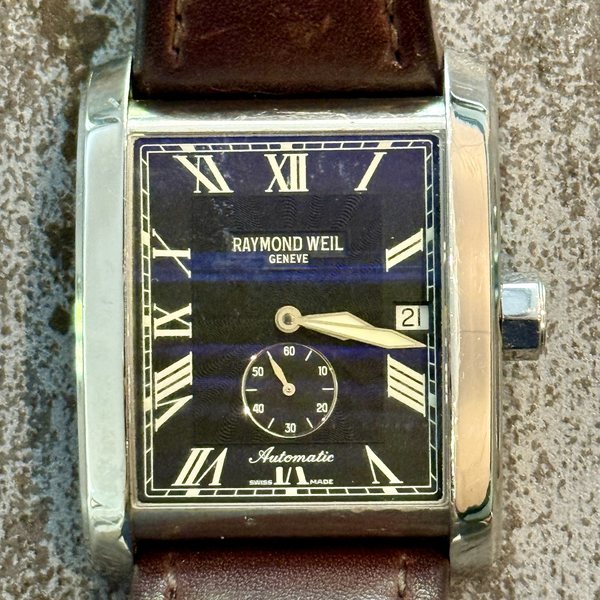
The dial — Roman numerals, small seconds, date, "Automatic" · photographed by the owner, July 2026 · all images hashed into the report snapshot
Dial · signed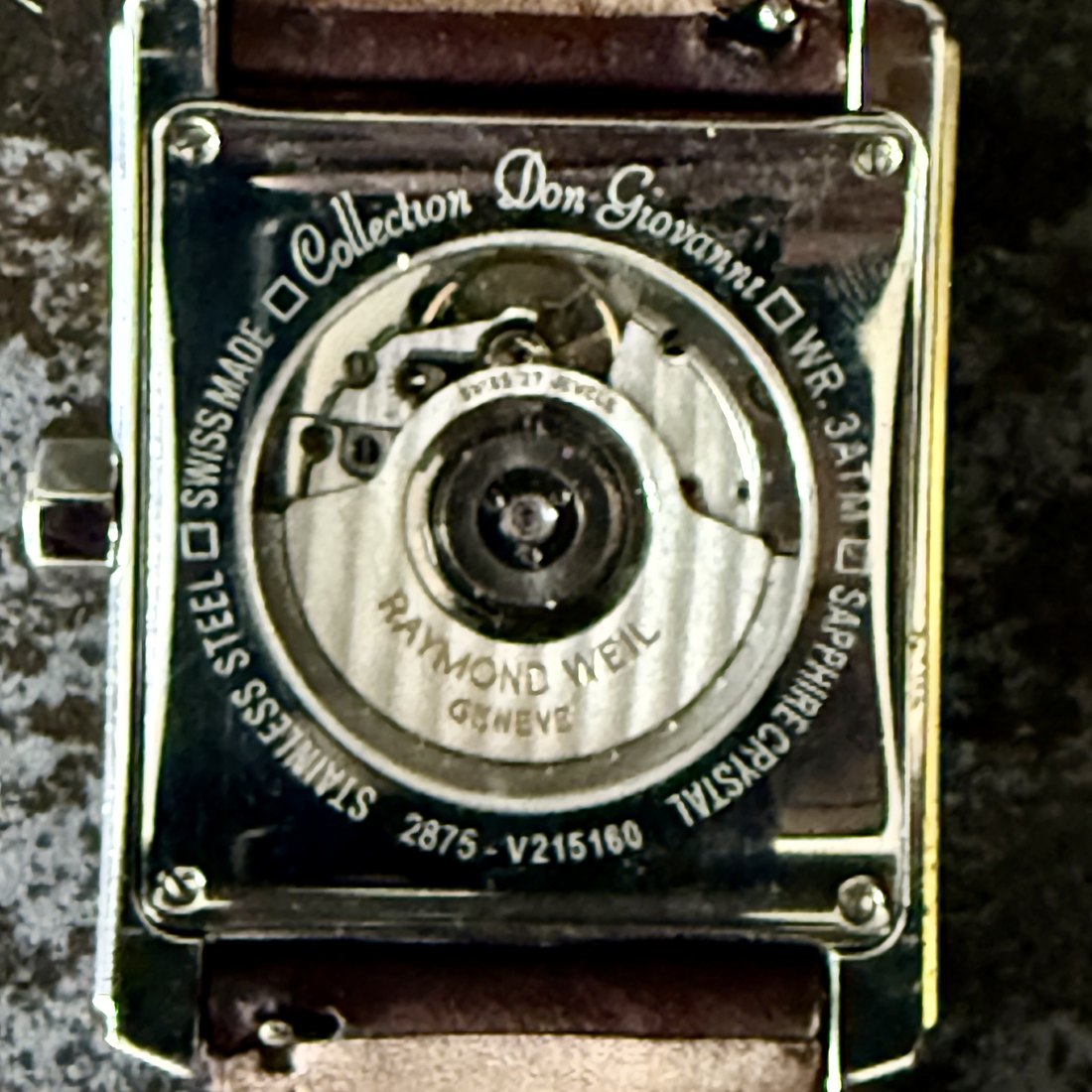 Caseback · 2875-V215160
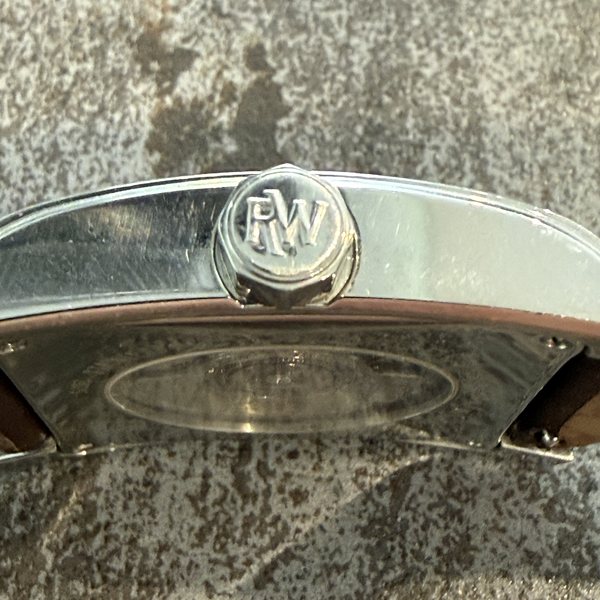 Crown · RW signed
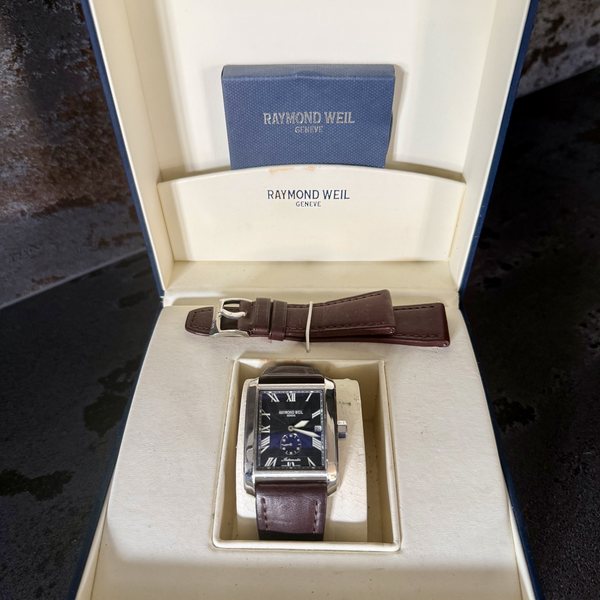 Box + booklet · on file
watchmaker session
lugs · clasp · crystal
Locked-tier disclosure — Silver: verification confidence moderate; verified with documented gaps — purchase receipt unlocated, movement uninspected, service history unknown. Transaction-suitable with that disclosure.
The registry sweep · every source namedSeven registries checked. One gap — published, not hidden.
| Registry | Scope | Checked | Result |
|---|---|---|---|
| Interpol stolen-works database | Object | 3 Jul 2026 | Clear |
| FBI Art Crime Team — national stolen art file | Object | 3 Jul 2026 | Clear |
| ICOM Red Lists | Category/patrimony | 3 Jul 2026 (Q2 dataset) | Clear |
| CBP repatriation registry | Object/patrimony | 3 Jul 2026 | Clear |
| Sanctions — OFAC · SECO · EU · UK OFSI | Parties | 3 Jul 2026 | Clear |
| Liens · litigation · encumbrances | Object/parties | 3 Jul 2026 | None found |
| Art Loss Register | Object | — | Not checked · Q3 2026 |
Stolen-property check covers Interpol, FBI Art Crime Team, ICOM Red Lists, and CBP repatriation registry. Art Loss Register integration scheduled Q3 2026. This report does not discharge the recipient's own diligence obligations under applicable cultural-property, sanctions, or AML law, including any duty to consult the Art Loss Register.
Material characterisation · declared vs observed vs referenceFor a watch, the keys are the serial, the movement, the case, and the weight.
| Measure | Declared | Observed | Reference |
|---|---|---|---|
| Reference & serial | Collection Don Giovanni · Ref 2875 · Serial V215160 | Engraved on the caseback and photographed — format and placement correct for the collection | Raymond Weil production records; serial format conventions for the period |
| Movement | Automatic, Swiss made (dial and caseback text) | Signed RW rotor visible through the sapphire display back — consistent with the collection's automatic calibre | Calibre confirmation and service state — watchmaker session, movement macro |
| Case & crystal | Stainless steel · sapphire crystal · WR 3 ATM (caseback text) | Case, engraving quality, screw-set display back and signed crown photographed; honest wear, no re-polishing red flags visible | Collection case specifications; factory finishing characteristics |
| Head weight & dimensions | Not recorded | Pending — calibrated scale and calliper at the watchmaker session | Reference population for the collection; weight is a first-order counterfeit screen |
Category note: in watches, identity rests on the serial-and-reference pair against maker records, and the movement must match the case — the classic fraud is the "franken" (right case, wrong heart). The display back lets this report observe the signed movement without opening the case; the watchmaker session turns observation into inspection. Every observed cell is backed by a hashed photograph.
The evidence · each photograph beside what it provesFour views, one box — and the movement in plain sight.
The caseback — Collection Don Giovanni · 2875-V215160
The full identity engraved in one place: collection, reference, serial, "Swiss Made · Stainless Steel · WR 3 ATM · Sapphire Crystal" — and through the display back, the Raymond Weil-signed rotor. Format, typography and placement consistent with the maker's production of this collection.
The dial — signed, small seconds, date, "Automatic"
Rectangular guilloché dial with Roman numerals, small-seconds register at six and date at three, signed RAYMOND WEIL GENÈVE with "Automatic" above six — the configuration matching this reference. Even ageing, no redial indicators (print crispness and lume consistency check out at photo resolution).
The crown — RW signed
Original signed crown, correct profile for the case. Replacement crowns are a common service substitution; an original one quietly corroborates the unbroken configuration.
Box, booklet, spare strap
The original Raymond Weil presentation box with booklet and a spare strap. "Box and papers" is the watch market's completeness standard — the box and booklet are on file; the purchase receipt is the paper still missing, and finding it is the single best re-run this record can buy.
The checks · horology profile · authority states shownNine checks, four sources — three held open, honestly.
| Check | Source · authority state | Result |
|---|---|---|
| Maker · collection · reference against production records | Caseback photograph · Raymond Weil recordsAuthority-resolved | Match |
| Serial V215160 — format, placement, engraving quality | Caseback photograph · serial conventionsAuthority-resolved | Match |
| Dial configuration against reference imagery | Dial photograph · collection referencesAuthority-resolved | Match |
| Movement signature — RW rotor through display back | Caseback photographAuthority-resolved | Observed |
| Crown — original signed furniture | Crown photographAuthority-resolved | Observed |
| Box and booklet accompany the watch | Box photographAuthority-resolved | On file |
| Movement inspection — calibre, condition, service state | Watchmaker session · movement macroMissing | Open |
| Original purchase receipt | Owner's records — search suggestedMissing | Open |
| Service history | No record locatedMissing | Open |
Why no curator flag: the category's primary identity keys — maker, reference, and serial — are photographed and authority-resolved. The open items are custody documents and the internal inspection; they hold two components down and widen the interval, but do not queue a review.
The path · what one afternoon and one receipt unlock
The collection graph · Enrich
A one-object graph today. Every verified object this owner adds corroborates the others — and the collection account holds them free, paying only for the actions. The record begins the day you photograph it.
Report attestation
6b350293da765434b15c3525a758165129f595e7b20847408f3fe69939eb9f7everify.veradis.ai/r/PCS-CH-2026-0001 (demo)The veradis signature attests to data integrity, not authenticity. Photographs are individually hashed into the snapshot. Hash-chained at the permalink.
Reproducibility. Re-running this method against this data snapshot reproduces this score to the digit (pinned-seed deterministic pipeline; golden tests in CI). Falsifiability. This method returns Flagged, with the evidence, when an identity fails its checks; appeals resolve within fourteen days. A verification that cannot say no would be worthless — this one can.
This Provenance Confidence Score is a probabilistic verification report based on digital data analysis cross-referenced against the veradis knowledge graph. It is intelligence, not insurance. The PCS reflects the probability of identity match, custody continuity, material integrity, and risk-profile cleanliness based on available data at the time of query. It does not constitute a legal certificate of authentication, a guarantee against loss, or an indemnity against fraud. For high-value transactions, buyers should conduct physical inspection by a qualified specialist. veradis is not liable for financial loss resulting from reliance on this report.
How to read this report · terms, colours, and the ± number
PCS (Provenance Confidence Score). A 0–100 measure of how well today's evidence supports this object's claimed identity and history. It scores the evidence, not the object's worth — and it is intelligence, not a certificate.
The four components. Identity match (does the object match the claimed identity), Custody & story (is the chain of ownership documented), Material integrity (do the physical signatures check out), Risk profile (registries, sanctions, encumbrances). They combine at fixed, disclosed weights: 30% · 30% · 25% · 15%.
± 6 · the 95% credible interval. The honest range around the score: given today's evidence, the true score sits between 76 and 88 with 95% confidence. Checks that have not been run do not lower the score — they widen this range. New evidence always narrows it; it may or may not move the number in the middle.
Tier — Gold / Silver / Bronze. Assigned on the bottom of the interval, not the middle: Gold 80+, Silver 60+, Bronze 40+. We tier on what the evidence can defend. This report: lower bound 76 → Silver. A failed identity returns Flagged, with the evidence enclosed.
Coverage (4/10 views). How much of the category's capture protocol is on file — a separate axis from the score. Partial coverage is why this interval is wide — and why filling slots is the cheapest way to tighten it.
Authority states. Authority-resolved — the value was confirmed against a named independent source (maker production records, serial conventions) and earns full credit. Declared-only — stated in a record but not yet independently confirmed; half credit. Missing — not yet on file; no credit, wider interval.
Declared / Observed / Reference. What the record claims · what has actually been measured or photographed · the published benchmark it is compared against.
"Clear" in the registry sweep means no match in the named registry on the check date — it never means "not stolen."
The colours. Deep green — supported by evidence on file. Brass — an honesty mark: a gap named, a component under 80, an action still open. Grey — unscored, unmeasured, or the Silver tier. Hollow dot — a check held open. Dashed border — exists but not yet on the platform (a pending capture, an off-platform document). Source dots: public registries · photography & documents · risk registries.
Snapshot & hash. Every version of this report is frozen as a data snapshot and fingerprinted (SHA-256); each version carries its predecessor's fingerprint, so the history cannot be silently rewritten. Verify any version at the permalink.