Wedding Tea Service — Tuscan Fine English Bone China, Rd 785452
Afternoon tea service for twelve · September 1939 · Owner: The present owner, British Columbia, Canada — daughter of the bride and the soldier · Companion: Appraise report
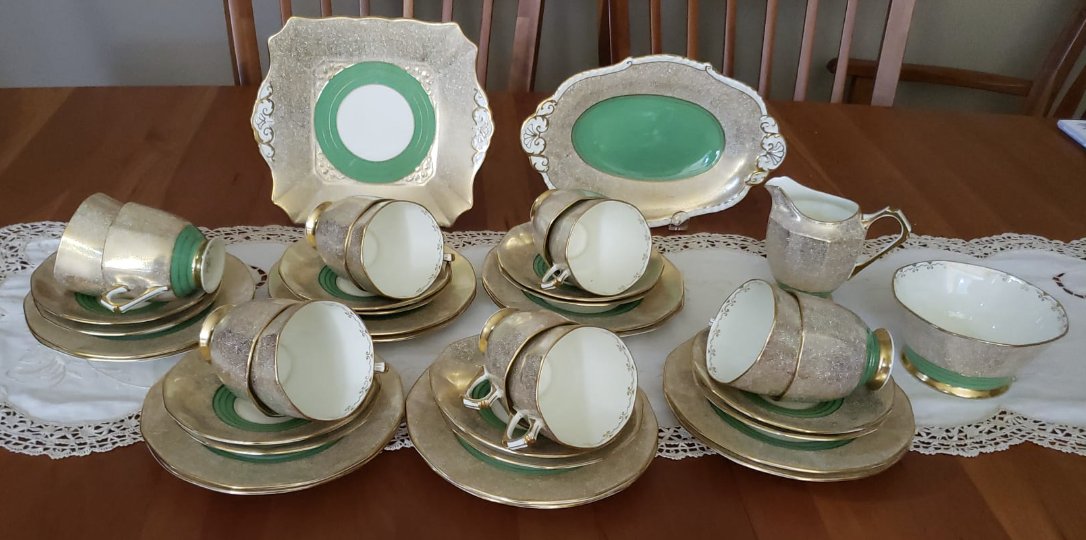
Trio and oval dish · gilt-encrusted "gold lace" over apple green · photographed by the owner, 2 July 2026 · all images hashed into the report snapshot
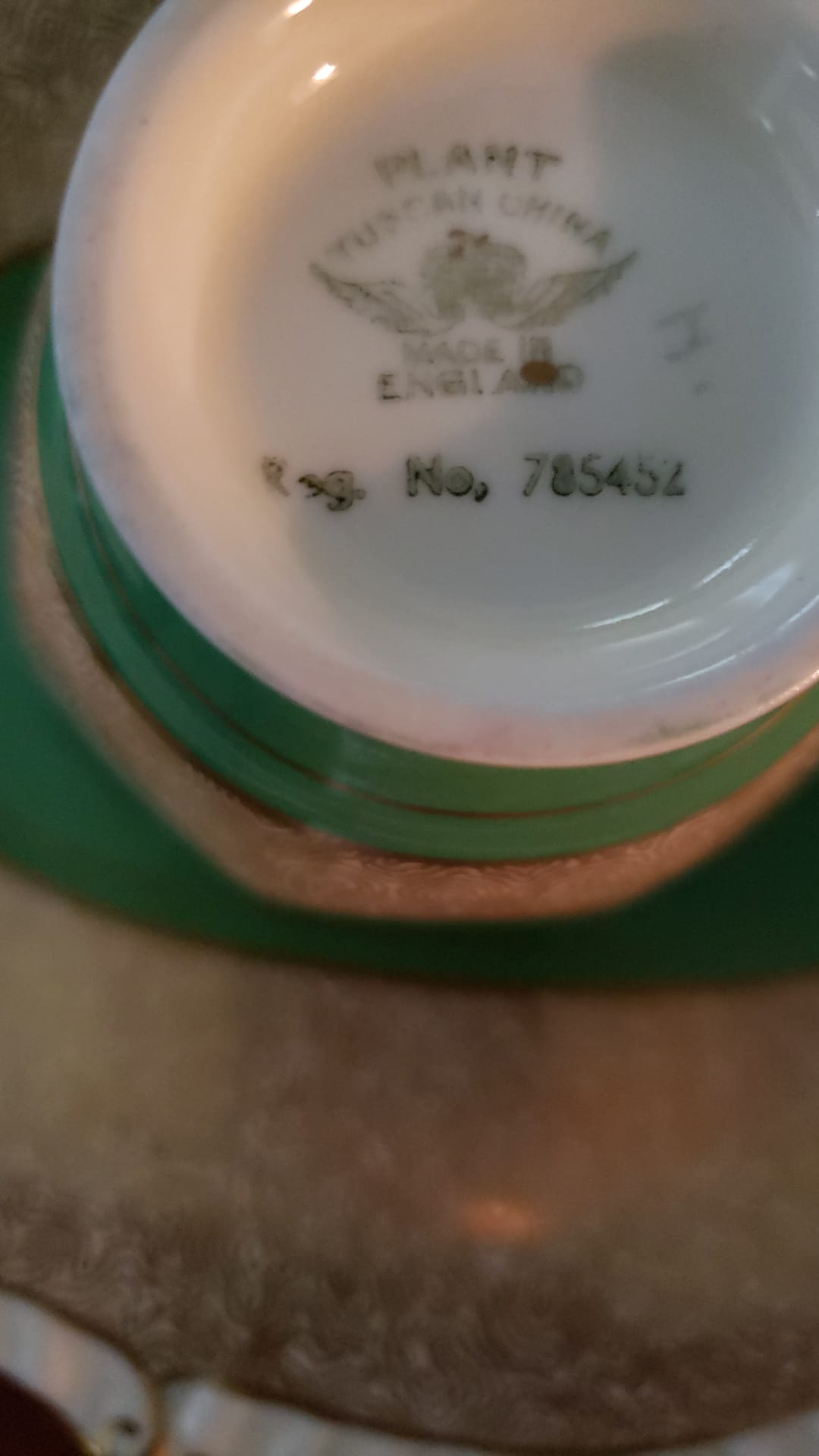 Backstamp · Reg. No.
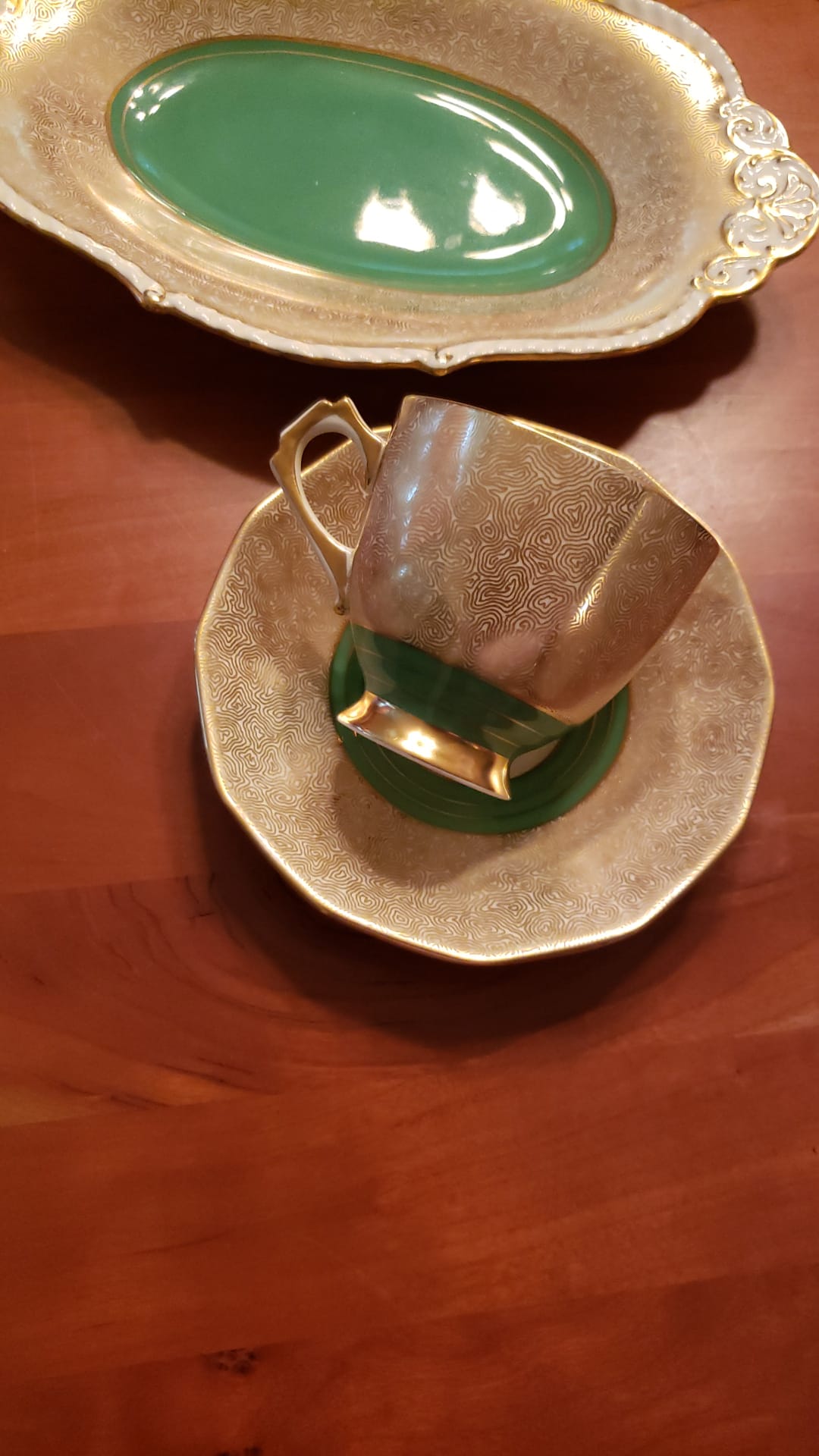 Trio + oval dish
view pending
 Cake plate & cups
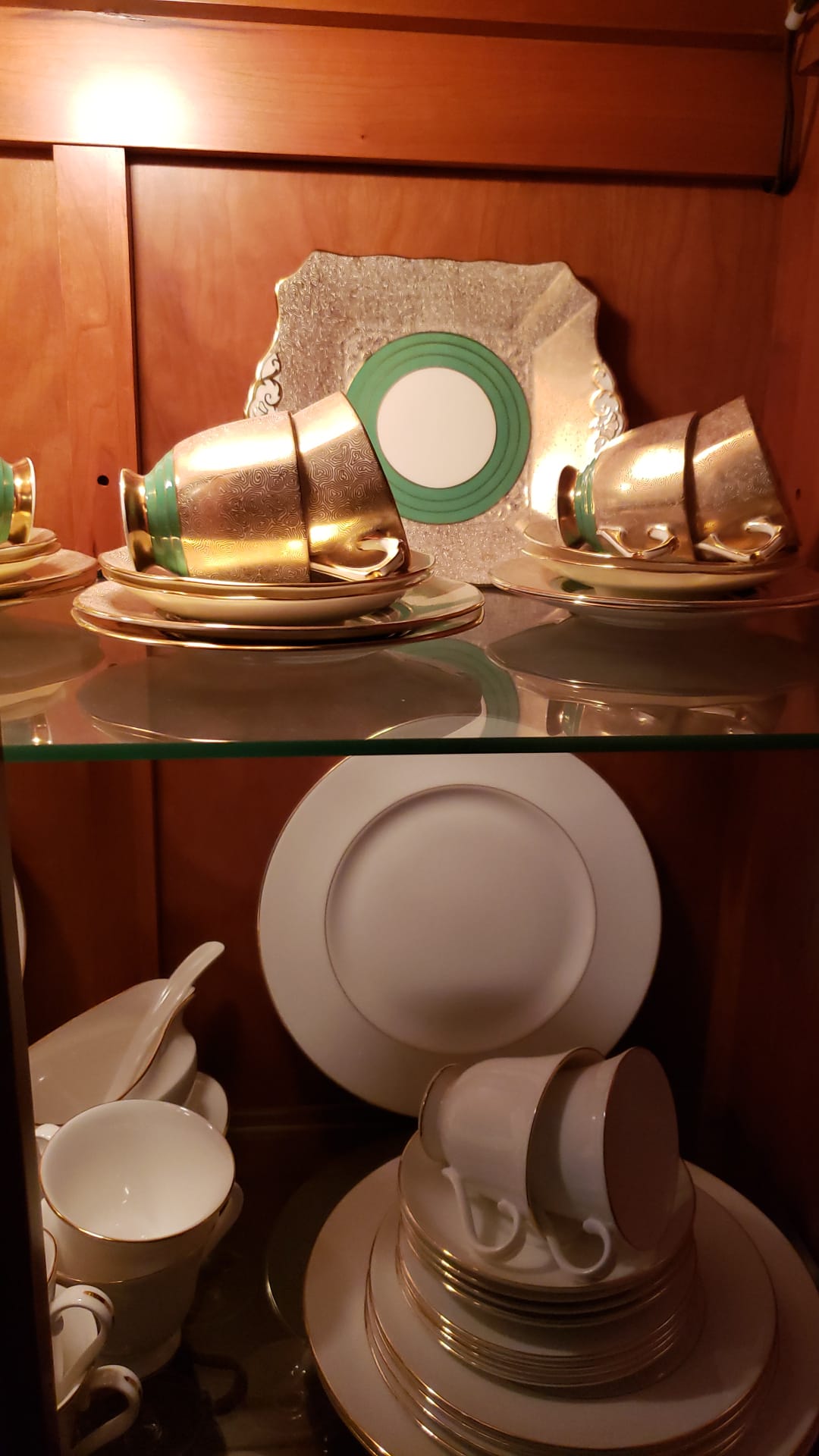 Sandwich tray
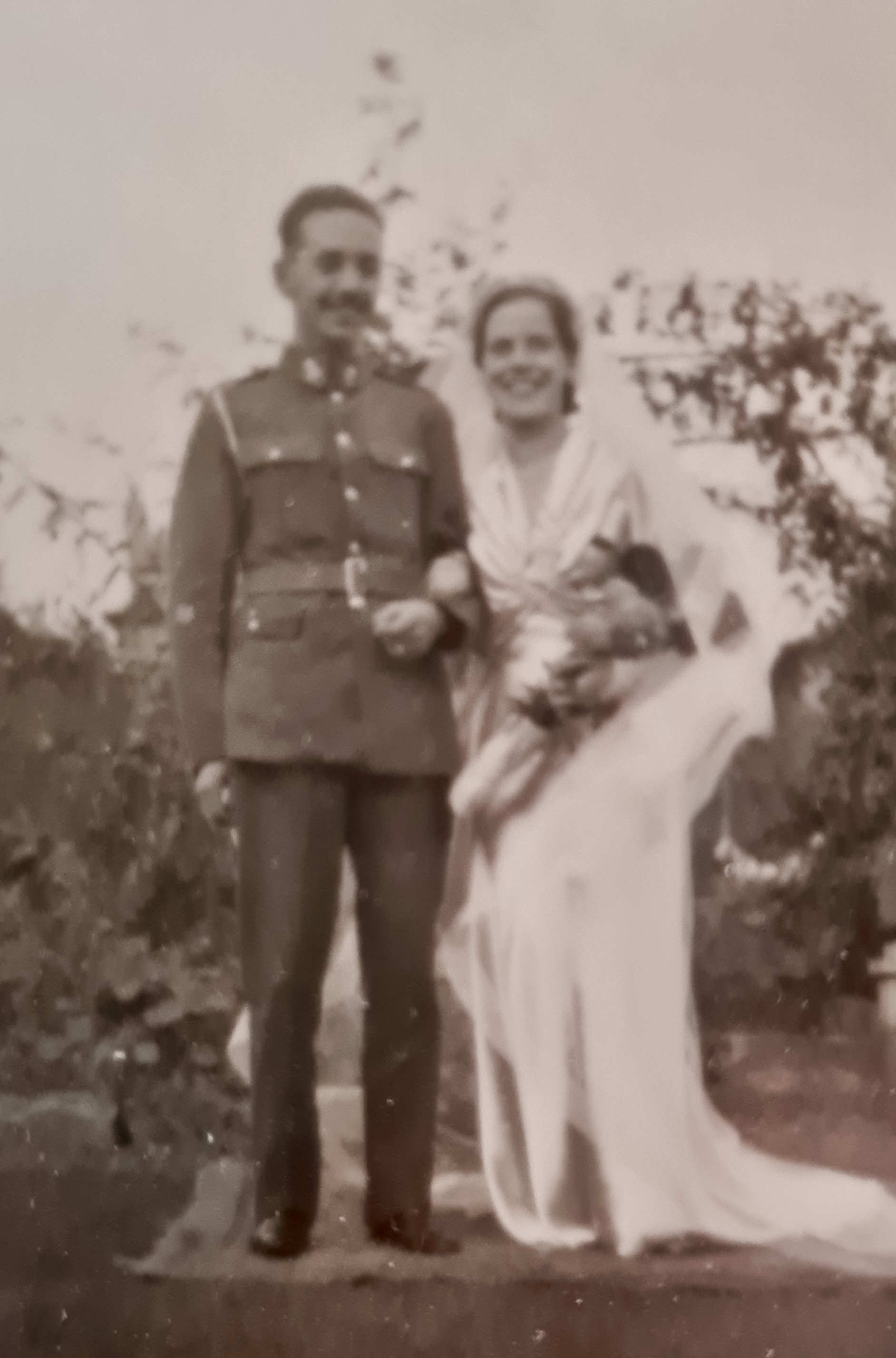 Wedding · 1939 · document
Locked-tier disclosure — Gold: verification confidence high; suitable for secondary-market transaction subject to the buyer's standard diligence and the liability terms below. The same method corrected another family's 1904 story last week. This one holds.
Material characterisation · declared vs observed vs referenceFor china, the keys are the body, the marks, the gilt, and the count.
| Measure | Declared | Observed | Reference |
|---|---|---|---|
| Body & translucency | Fine English bone china, R.H. & S.L. Plant Ltd, Longton | Consistent — thin-walled translucent body per raking-light session (illustrative) | Bone-china body characteristics for Staffordshire production of the period |
| Backstamp & marks | PLANT winged-crown · TUSCAN CHINA · MADE IN ENGLAND · Reg. No. 785452 | Photographed and matched — pre-1966 mark wording; decorator's painted mark present | Published Plant mark chronology · British Rd registry table (785452 → 1933) |
| Gilding | Gilt-encrusted "gold lace" over apple-green bands | Bright throughout; engraved vermicelli texture; minor wear to two cup rims — photographed and disclosed | Gilt-encrusted decoration class — the labour-intensive top of the maker's range; regilding would show tonal breaks |
| Count & completeness | Afternoon service for twelve with serving suite; no teapot, as retailed | Counted at the layout session (illustrative): twelve settings plus five serving pieces — 41 pieces | Period retail configuration for gilt afternoon services — tea poured from the family silver |
Category note: china carries no serials — identity rests on the mark system and the registered-design number, and the intake hints exist because owners misdeclare number types (this service's "serial" was a registered design; another family's "Rd" was a pattern number). Every observed cell above is backed by a hashed photograph in the evidence panel.
The evidence · each photograph beside what it provesTwelve views, two documents, one linked object.
Backstamp — PLANT · TUSCAN CHINA · Reg. No. 785452
The winged-crown mark of R.H. & S.L. Plant Ltd, Longton, with "MADE IN ENGLAND" and the registered design number printed on the piece. Rd 785452 sits between 779292 (1933) and 789019 (1934): the design was registered in 1933. A decorator's painted mark sits beside the stamp.
Trio with the oval two-handled dish
Gilt-encrusted "gold lace" decoration with engraved vermicelli texture over apple-green bands — the labour-intensive top of Plant's decorative range. Gilding bright and unbroken on the photographed surfaces.
view pending
Cream jug and sugar bowl
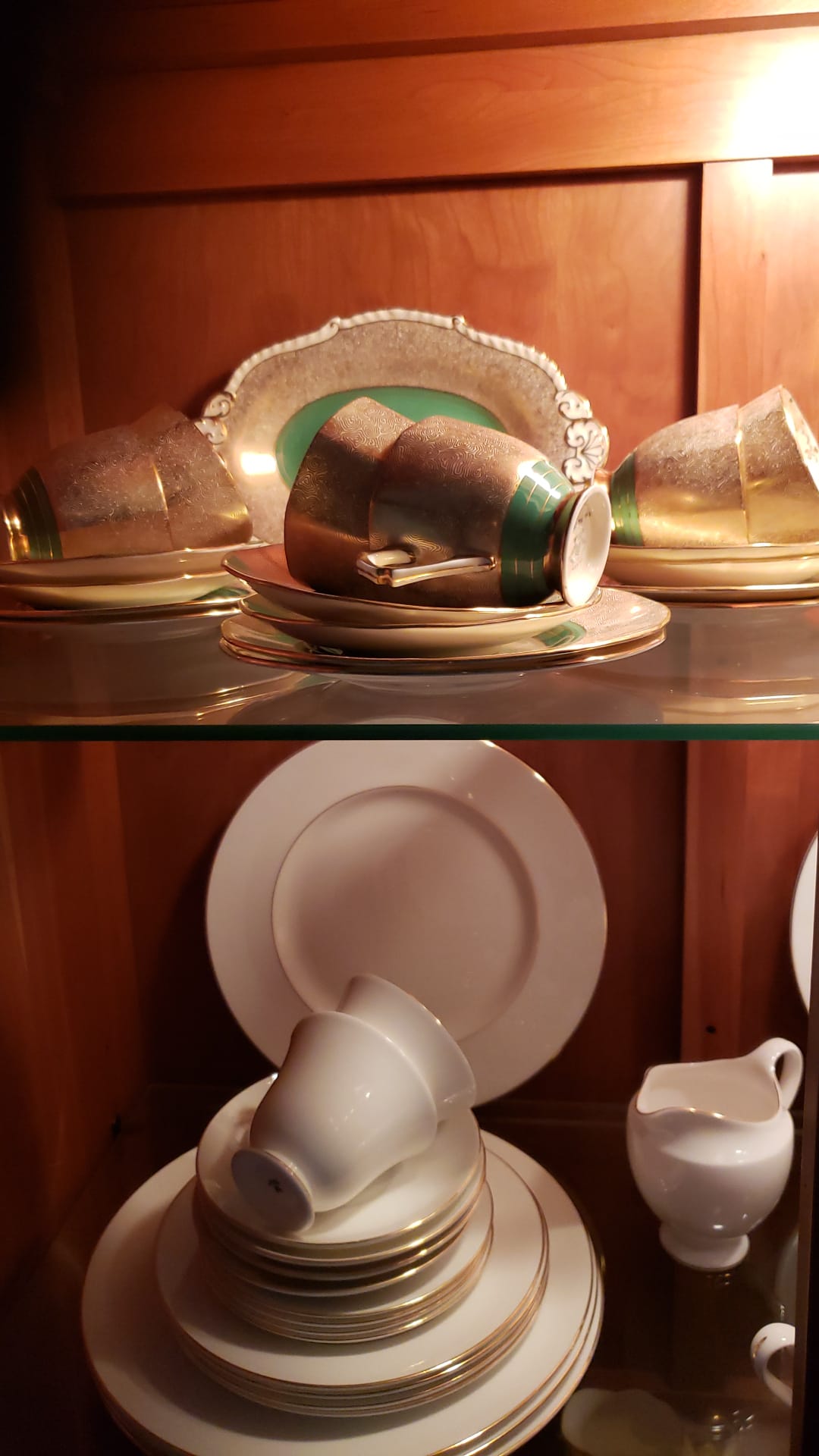
Observed in the cabinet and pattern-consistent with the settings; a dedicated photograph completes this slot — and is the capture that narrows the interval next. The white-and-gilt service on the lower shelf is a separate object with its own record available.
Scalloped cake plate with nested cups
The scroll-edged cake plate standing behind three nested cups on stacked saucers and side plates — the depth of the stacks consistent with a twelve-person service.
Square sandwich tray, green ring centre
The most distinctive piece in the service and the natural listing photograph. Count confirmed at the full-layout session (illustrative): twelve settings plus five serving pieces; the service was retailed without a teapot — tea poured from the family silver, as was common for gilt afternoon services of the period.
The wedding photograph — September 1939
The bride and the soldier, the groom in uniform weeks into the war. The dated origin of the service: a 1933-registered pattern given as a current pattern in 1939. The timeline checks.
The checks · ceramics profile · authority states shownEleven checks, five sources — one held open, honestly.
| Check | Source · authority state | Result |
|---|---|---|
| Maker · trade name · winged-crown mark | Backstamp photograph · maker recordAuthority-resolved | Match |
| Reg. No. 785452 on piece · 1933 registry | Backstamp photograph · British Rd tableAuthority-resolved | Match |
| Pattern family — gilt-encrusted, apple green | Trio photographAuthority-resolved | Identified |
| Serving suite (5 pieces) · pattern consistency | Cabinet photographsAuthority-resolved | Observed |
| Counted layout — twelve settings (illustrative) | Full-layout sessionAuthority-resolved | Confirmed |
| Condition — raking light, interiors (illustrative) | Full-layout session · minor gilt wear, two cup rimsAuthority-resolved | Documented |
| Teapot — service complete as retailed | Family confirmation · period retail practiceDeclared-only | Resolved |
| Origin against pattern timeline | 1933 registration vs September 1939 giftAuthority-resolved | Coherent |
| Wedding photograph — date consistency | Groom in uniform · war declared 3 Sept 1939Authority-resolved | Consistent |
| Origin corroborated — the soldier independently documented | Family graph · linked medal group (see below)Authority-resolved | Corroborated |
| Chain to present owner (mother → daughter) | Family record — will extract would formaliseDeclared-only | Open |
The family graph · Enrich
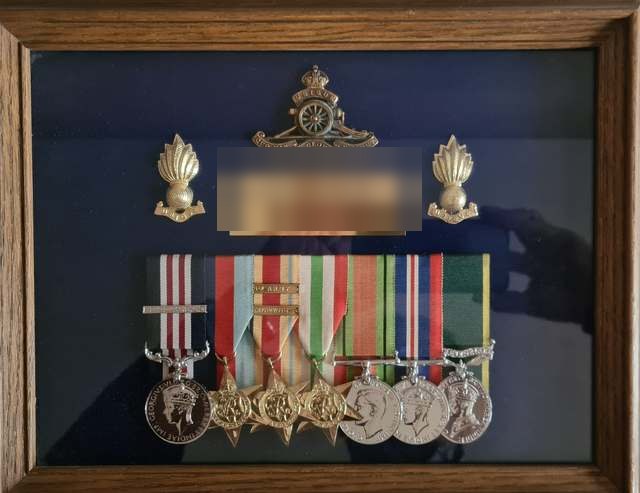
Each object corroborates the others; each addition strengthens the whole. The family is the institution.
Report attestation
f1136743bac97884737583520f483cc58b2c54f40c5ff7b1cfd9e6d604db0378verify.veradis.ai/r/PCS-CH-2026-0003 (demo)The veradis signature attests to data integrity, not authenticity. Photographs are individually hashed into the snapshot. Hash-chained at the permalink.
Reproducibility. Re-running this method against this data snapshot reproduces this score to the digit (pinned-seed deterministic pipeline; golden tests in CI). Falsifiability. This method returns Flagged, with the evidence, when an identity fails its checks; appeals resolve within fourteen days. A verification that cannot say no would be worthless — this one can.
This Provenance Confidence Score is a probabilistic verification report based on digital data analysis cross-referenced against the veradis knowledge graph. It is intelligence, not insurance. The PCS reflects the probability of identity match, custody continuity, material integrity, and risk-profile cleanliness based on available data at the time of query. It does not constitute a legal certificate of authentication, a guarantee against loss, or an indemnity against fraud. For high-value transactions, buyers should conduct physical inspection by a qualified specialist. veradis is not liable for financial loss resulting from reliance on this report.
How to read this report · terms, colours, and the ± number
PCS (Provenance Confidence Score). A 0–100 measure of how well today's evidence supports this object's claimed identity and history. It scores the evidence, not the object's worth — and it is intelligence, not a certificate.
The four components. Identity match (does the object match the claimed identity), Custody & story (is the chain of ownership documented), Material integrity (do the physical signatures check out), Risk profile (registries, sanctions, encumbrances). They combine at fixed, disclosed weights: 30% · 30% · 25% · 15%.
± 4 · the 95% credible interval. The honest range around the score: given today's evidence, the true score sits between 81 and 89 with 95% confidence. Checks that have not been run do not lower the score — they widen this range. New evidence always narrows it; it may or may not move the number in the middle.
Tier — Gold / Silver / Bronze. Assigned on the bottom of the interval, not the middle: Gold 80+, Silver 60+, Bronze 40+. We tier on what the evidence can defend. This report: lower bound 81 → Gold. A failed identity returns Flagged, with the evidence enclosed.
Coverage (12/12 views). How much of the category's capture protocol is on file — a separate axis from the score. Complete coverage is why this interval is tight.
Authority states. Authority-resolved — the value was confirmed against a named independent source (maker record, design registry) and earns full credit. Declared-only — stated in a record but not yet independently confirmed; half credit. Missing — not yet on file; no credit, wider interval.
Declared / Observed / Reference. What the record claims · what has actually been measured or photographed · the published benchmark it is compared against.
The colours. Deep green — supported by evidence on file. Brass — an honesty mark: a gap named, a component under 80, an action still open. Grey — unscored, unmeasured, or the Silver tier. Hollow dot — a check held open. Dashed border — exists but not yet on the platform (a pending capture, an off-platform document). Source dots: public registries · photography & documents · risk registries.
Snapshot & hash. Every version of this report is frozen as a data snapshot and fingerprinted (SHA-256); each version carries its predecessor's fingerprint, so the history cannot be silently rewritten. Verify any version at the permalink.